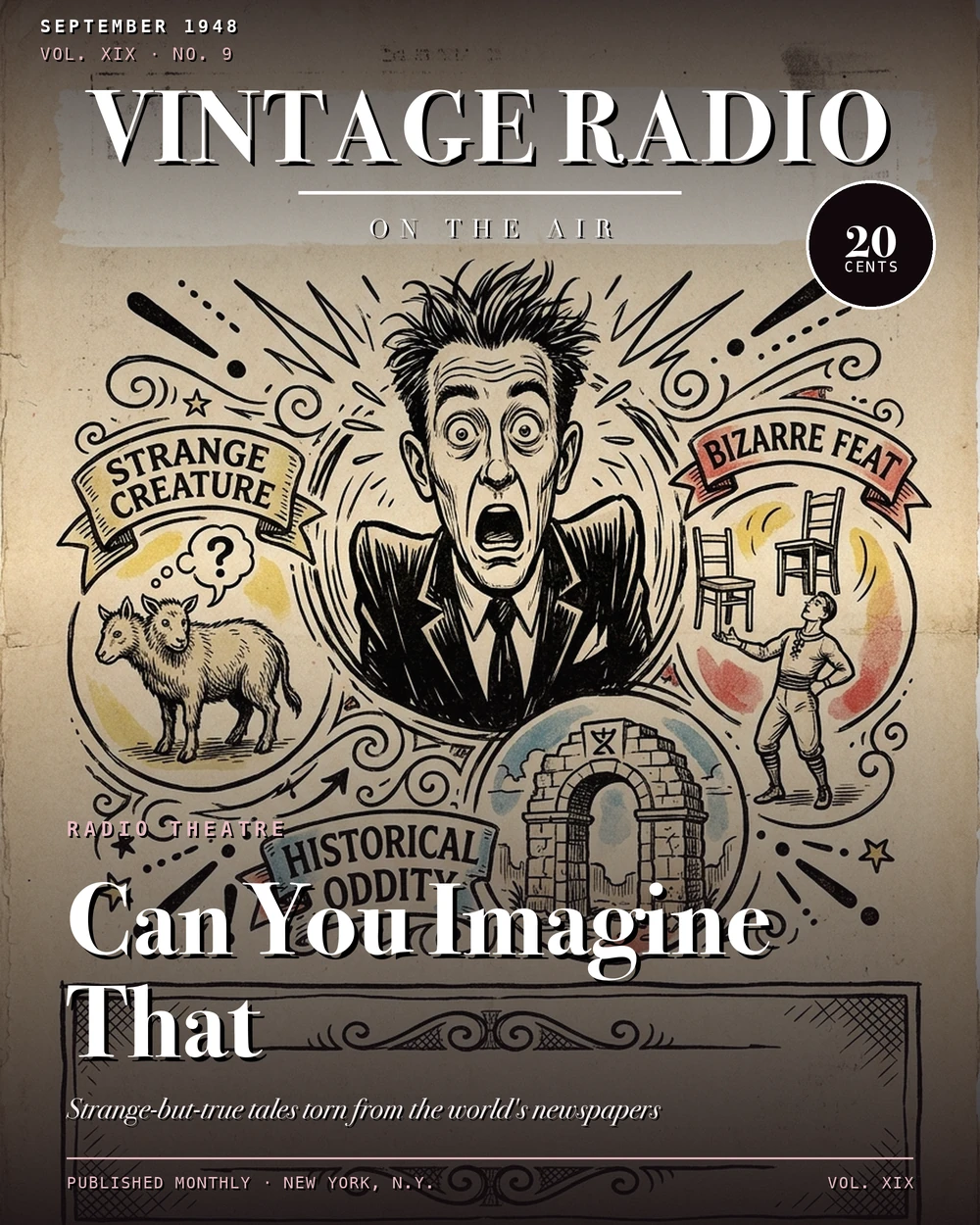
Can You Imagine That
Strange Stories, Dramatized
The premise of Can You Imagine That was simple and unabashedly entertaining: take the strangest, most surprising items from newspaper columns across the country, dramatize them in short vignettes, and package the whole thing into a brisk fifteen-minute syndicated program. No high-minded agenda, no serious current-events analysis — just odd news, historical curiosities, and the kind of "can you believe it?" stories that made readers stop and read a column twice. The show aired in 1940 on West Coast radio stations as a syndicated production, not a network broadcast, which gave it a somewhat different circulation path than the big national programs of the era.
The format was efficient and well-organized. Each episode opened with a quick tease of three or four oddities that were coming up, then broke for a 90-second commercial, and then delivered the vignettes. With four to six topics crammed into roughly twelve minutes of actual script time, the pace was fast. Dramatizations led the way, and episodes often closed with a short piece about the history of a popular or old song of the era — a nice bit of variety that kept the ending from feeling like another hard news item.
The catalog contains 39 episodes, and the episode titles alone suggest the range of material: War Prediction, Joan of Arc, Chimp Language, Explosion Heard Three Thousand Miles Away, Frightened Out of Speech, Marriage Customs, Five Men Swindled, Reward Nineteen Years Later. The show cast a wide net — ancient history, natural oddities, crimes, legal quirks, animal behavior, and folk customs all qualified as fair game. What unified them was the "can you believe it?" quality each story carried.
The Man Behind It
The show was the work of Lindsay MacHarrie, who wrote, directed, acted in many of the vignettes, and served as host and narrator for the entire run. MacHarrie came to the project with a solid background in Hollywood radio. He had worked as a prolific producer at KHJ and KMPC, and a 1930 trade press item noted him moving from chief announcer to production manager at KHJ — a career arc that gave him a thorough grounding in how radio production actually worked, from the microphone outward.
MacHarrie is also credited as the producer of The Cinnamon Bear, the holiday serial that first aired in 1937 and became a perennial favorite in some markets. That program showed he could sustain a serial with audience appeal across multiple weeks; Can You Imagine That put different demands on him, requiring fresh oddities and a consistent light touch every episode rather than a continuous narrative.
A sales presentation recording that surfaced later confirms Bud Hiestand introducing MacHarrie, who described how the program came about. After its initial run, the series was syndicated through Bruce Eells' Broadcaster's Program Syndicate, among others, which helped it reach stations beyond its original West Coast audience.
How It Compared
Contemporary observers placed Can You Imagine That in the same general territory as Ripley's Believe It Or Not, Strange as it Seems, and Can You Top This? — programs that shared its appetite for improbable-but-true material. Information Please was another comparison point, though that show leaned more toward quiz-format intellectualism. What these programs had in common was a format built around surprise and the audience's pleasure in learning something they hadn't known before.
The show wasn't trying to reinvent radio journalism or challenge conventional news formats — it wasn't a particularly historic or ground-breaking production and was simply entertaining. That's an honest description. The vignettes were well-crafted enough — sound effects helped create vivid mental imagery, and the narrative techniques kept each short segment from feeling flat — but the goal was amusement, not illumination.
That said, the historical vignettes have aged reasonably well, holding up even seventy years hence — a decent run for topical entertainment radio. Part of that durability comes from the fact that strange history doesn't go stale the way commentary on current events does.
What Survives
The series was certified as complete in December 2010, with that release identified as the most complete and accurate version then in circulation — a single CD's worth of material representing all 39 known episodes. The certification process involves cross-referencing known copies, correcting audio degradation where possible, and establishing the most reliable episode sequence. Episode filenames in the archive are coded with the prefix 40-xx-xx, which is part of why researchers consistently date the series to 1940 rather than accepting the conflicting dates that appeared in some earlier catalog records — a few legacy listings placed the show in 1951–1953, and one episode database even tagged it 1922, but the filename evidence and the consensus of independent sources settle the matter on 1940.
The 39 episodes represent the full known run of the series. Whether additional recordings exist somewhere that haven't been matched to the catalog is unknown, but the certified set represents a reasonable accounting of what's accessible. For a syndicated program from 1940 that aired regionally rather than on a national network, having 39 episodes survive is a reasonable outcome — syndicated shows often fared worse in terms of preservation, partly because there was no single archive keeping copies and partly because the programs were produced in smaller runs with less institutional investment in their long-term survival.